From reporting results to planning them
What sales pipeline can you expect from a particular campaign budget? And if the pipeline target is already set, what customer selection and level of effort could support it?
These two questions were central to a telemarketing project. Previously, campaign outcomes were judged afterward as good, less good, or poor. The important improvement was being able to estimate outcomes during planning.
Corvendor developed a basis for connecting budget and target selection to expected qualified leads and sales pipeline. This made the discussion more concrete before a campaign started: What do we want to achieve, which customers should we approach, and what resources should we commit?
Two ways to support a planning decision
Start with the available budget. A business department has a budget and a customer selection. It needs an expectation of the qualified leads and pipeline the campaign could generate. Different combinations of budget and selection become planning options that can be compared.
Start with the desired outcome. A business department has a pipeline target. The question becomes which combination of budget and customer selection could support it. The target is connected to the resources and selection needed to pursue it.
The project supported both directions. This gave the responsible managers a better basis for aligning resources with expected outcomes. A forecast remained an expectation, rather than a commitment to a particular individual result.
Two planning directions
- Budget + customer selection
- Expected leads + sales pipeline
- Pipeline target
- Suitable combination of budget + customer selection
Why customer selection matters
The budget influenced how many calls could be made. Expected results also depended on which companies were approached. Selection included characteristics such as company size and the customer relationship: Was the campaign intended to acquire new customers, develop existing accounts, or support retention?
These distinctions gave the planning a business context. A campaign aimed at new customers serves a different purpose from one aimed at developing existing relationships. A budget figure alone does not adequately describe those differences.
Comparable planning also requires clear outcome definitions. Business owners define what counts as a qualified lead and which opportunities belong in the pipeline. Sales pipeline represents potential business; it is not booked revenue.
What Corvendor built to make it work
The planning depended on several connected components. The international campaign operation involved around 200,000 calls per year. Making predictions and customer selection usable in practice required the following work:
Clean and prepare the data. Data cleaning required more effort than initially expected. It established the foundation for using customer information and campaign outcomes together in planning.
Create around one million account profiles. These structured profiles combined information including company size, purchase patterns, revenue, sales pipeline, and past marketing engagement. They made relevant account characteristics available for analysis and selection.
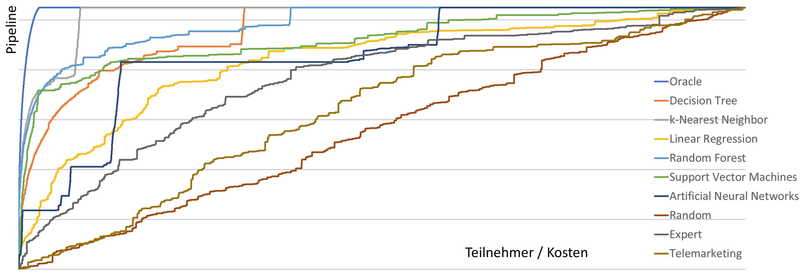
Use machine learning for predictions and selection. Machine learning was used to predict campaign outcomes and select accounts when only a fraction of a large customer pool could be called. Different modeling approaches were compared with one another and with expert, telemarketing, and random selection. A score combined the predicted pipeline amount with a probability for the particular account, product line, and current timing. Selection depended on the campaign goal: broad customer coverage or the greatest expected pipeline from the available calling capacity.
Introduce consistent reporting and dashboards. Reporting was standardized across campaigns. This provided a shared view of results to support comparison and campaign management.
Corvendor connected these components with implementation in existing workflows. The solution also supported project planning, coordination of participating agencies, and structured transfer of leads to sales.
Collaboration across departments was essential. The organization contributed its knowledge of customers, offers, and sales activity. Corvendor connected that domain knowledge with data preparation, modeling, software, and planning that the teams could use in the business.
The limitation: unusually large opportunities
Results became more predictable. Exceptionally high pipeline values nevertheless remained a forecasting limitation. One large opportunity can have a substantial effect on a campaign's total pipeline.
It is therefore useful to examine qualified leads and pipeline separately. Lead volume and the value of the resulting opportunities answer different questions. A high pipeline value alone does not establish how reliably a comparable result can be repeated.
The improvement was connecting expectations to campaign inputs and supporting decisions before the campaign began. It does not mean that every subsequent campaign can be guaranteed to meet its forecast exactly.
What a comparable project would need today
A similar approach can be useful when campaigns recur, selection and effort can be adjusted, and outcomes can be associated with the relevant activities. For a new project, we would first establish:
- Which decision should the planning support: budget allocation, customer selection, or a specified pipeline target?
- What information is available about earlier campaigns, customers approached, and subsequent outcomes?
- How do your domain experts define a qualified lead and the associated pipeline?
- Who will use the planning, who will review its assumptions, and how will actual outcomes feed back into it?
If these foundations are missing, a useful first step may be to bring the data and outcome definitions together. The appropriate rules or models depend on the particular question and available evidence.
How to assess its value
For a new implementation, we would record expectations before a campaign starts and compare them with actual outcomes afterward. The observation period and outcome definitions should be agreed in advance. Qualified leads, pipeline, and unusually large opportunities would be examined separately.
The planning should also help with a concrete decision. Can managers assess budget alternatives? Can they see which selection fits a goal? Can they explain their assumptions and investigate differences between expected and actual results?
This kind of planning becomes valuable when it is used in the business. It provides a shared basis for discussing what appears achievable with the available resources — and what would need to change to achieve more.